Saturday, May 7, 2016

Movie Review - Captain America: Civil War

Captain America: Civil War/Marvel Studios/Dir. by Anthony and Joe Russo/Rated PG-13 for extended sequences of violence, action and mayhem

Story, story, story.  This is the well-known mantra of Pixar studios and you can certainly tell which of their films adhere to it and which don't.  This mantra has also been embraced by Marvel Studios.  From the beginning of the Marvel Cinematic Universe, the stories have been thoughtfully crafted, the motivations and humor have been built from character, and the cross-connections throughout franchises have been carefully planned.  Whereas another well-known comic-based cinematic universe seems to be of the mindset of "characterization be hanged, we need a Justice League movie and we need it now!," Marvel has been building these worlds and characters for almost a decade now and the work pays off spectacularly in their latest opus, Captain America: Civil War.

As a direct result of the events of Captain America: Winter Soldier and Avengers: Age of Ultron, the world is equally appreciative and leery of the superteam known as the Avengers.  After an accident in Laos which resulted in civilian casualties, the U.N. has decided the superpowered of the world have to be put in check, thus the drafting of the "Sokovia Accords," named after the area destroyed after the Avengers battled Ultron.  In essence, it requires that the Avengers be under the control of an advisory board of the U.N., restricting their involvement to only sanctioned situations.  The members of the Avengers are being pressured to sign the accords.  If they don't they will not be able to legally continue their work, making them vigilantes.

In addition, The Winter Soldier (a.k.a. Caps old friend, Bucky Barnes) seems to be responsible for a terrorist act, causing Captain America, who believes his friend to be innocent, to race to find and save Bucky before the council can fulfill their "find and shoot to kill" orders.  

One of the delightful aspects of this film is, while the action is thrilling and jaw-dropping, it takes it's time building to them, crafting thoughtful and well-acted scenes of dialogue making decisions and motivations crystal clear before plunging characters into the fray.  These scenes are expertly paced with a dramatic rhythm and a level of writing that makes the action scenes feel like the natural extension of these conflicts.

This has one of the largest ensembles of heroes of any of the Marvel films and, quite miraculously, it never feels over-stuffed.  Every character has a reason for being their and, even more miraculously, every character has a glory moment.  New team members include Black Panther (fantastically played by Chadwick Boseman), a Wakandan prince with a mission of vengeance, and the new incarnation of Spider-Man (played with a delightful humor and innocence by Tom Holland), which is, quite simply, the most faithful to the comics version of the character ever placed on film.  Yes, this is a Captain America film and his friendship with Bucky and his respectful/combative relationship with Tony Stark are at the film's core, but the side characters are rich and provide some of the best moments of the film.  Without getting into spoilers, the battle at an airport tarmac in Germany is quite simply one of the most delightful, intense, surprising, flat-out fun scenes I've ever seen and each individual character plays an integral part in its success.

You should be forewarned that if you're a fan of the Civil War comic series, this is quite a bit different.  No spoilers, but don't expect the same outcomes.  Yes, the MCU is integrally different by the end, but not for the same reasons the presented in the comics.  Frankly, I prefer this version in that its conclusions are a little more open-ended, which leaves the future for these characters wide-open.

The Russo brothers do a fantastic job directing, providing a sure pacing and visual artistry that masks the film's 2 1/2 hour run time, in spite of which, I could have easily turned around and watched it again.  The Russo's were controversial choices for Captain America: Winter Soldier because of their background in sitcoms, most famously Arrested Development and Community (which reminds me, Jim Rash, a.k.a. Dean Pelton, has a delightful cameo in Civil War), but having proved themselves with that film and simply nailing this one, they have now been handed the keys of the MCU, currently prepping the Avengers: Infinity War films.  The complexities of this film may have blurred my allegiance to Team Cap or Team Iron Man, but I'm firmly on Team Russo.

Final Verdict: One of the most emotionally complex and wildly imaginative films of the MCU, Captain America: Civil War is an easy recommendation for anyone who likes their movies equal parts thoughtful and fun.  Grade: A

Friday, March 25, 2016

Movie Review: Batman v Superman: Dawn of Justice

Batman v Superman: Dawn of Justice/Warner Bros./Rated PG-13/Dir. by Zack Snyder

In the beginning (a.k.a. the 70's and 80's), quality superhero films meant DC/Warner Bros.  There was Superman and Batman and everyone else.  Richard Donner's Superman films were revolutionary in how seriously and respectfully they treated material that had previously been quite literally considered kid's stuff.  Tim Burton's two-film take on Batman almost completely erased the image of Adam West punning it up in tights with colorful text cards letting us know that the correct sounds of someone getting hit were "Pow!" and "Bang!"  For Marvel, these were the dark years.  When Captain America was played by the guy from the classic MST3K episode Space Mutiny and Howard the Duck was the biggest Marvel feature-length movie.

Of course, a couple decades later, things were different.  Superman fought Richard Pryor and nuclear war and ended up killing his own franchise, while Batman met his doom with Joel Schumacher replacing grit and character with kitsch and those infamous nipple-enhanced armor plates.

However, in the mid-2000's both of the rival comic companies seemed to be getting the idea of how to make great movies.  Marvel, who had sold the movie rights to their biggest properties, watched as Sony very wisely handed the keys of the Spider-Man franchise to Sam Raimi, a man who loved the comic, but who had spent his early career working in character-driven independent horror and drama films, guaranteeing that both the spectacle and the grounding emotive elements would be in place.  Warner Bros.  followed Sony's lead by hiring Christopher Nolan to take over Batman and Bryan Singer (who had previously brought the X-Men to screen with great success) to handle Superman.  The resulting films, Batman Begins and Superman Returns respectively, were equally well-received financially and critically.  Unfortunately, WB wanted a lot more success from Superman because they had previously spent a lot of money on an aborted Superman movie and wanted to recoup their loses, so they let Nolan continue with Batman, but put the hold on more Supes movies.  Of course, during this time, Marvel began their own cinematic universe with the properties they still owned, brilliantly taking their time to build character by perfectly matching director with material.  Even as Marvel introduced new characters to the MCU, they made each film feel like an extension of the previous films.  It was a level of inter-connectivity that had never been tried before in film.  It was wildly successful, but at the time was a huge risk.  After The Avengers, though, all bets were off and DC knew it needed to get into the "cinematic universe" game.

I give this little history recap because these events are integrally related to the quality of the DC/Warner Bros. film Batman v Superman: Dawn of Justice.  Just look at that title.  Whereas the first mention of The Avengers was in a post-credits stinger scene snuck into Iron Man, everything about this film, starting with the title, screams "DC HAS A SUPERGROUP TOO!!!!  AND IT'S GOING TO BE AMAZING!!!  AND MAGICAL!!!!  WITH COOLER POWERS!!!  TAKE THAT MARVEL!!!!!"   This movie was obviously rushed into production in order to catch up with the runaway freight train that is the MCU and it reeks of that desperation.  It's not a bad movie, it's just a frantic, haphazard, and somewhat soulless place holder for the eventual Justice League mega-movie-event.

One of the smartest things director Zack Snyder did was connect BvS with his controversial ending act of Man of Steel.  Well, either smart or extremely arrogant, as he has long defended that ending, which jettisoned everything that Superman the character and Superman the comic ever stood for in favor of Transformers-style chaotic city-wide mayhem and destruction.  However, in making those events the catalyst for Bruce Wayne's (appropriately dourly played by Ben Affleck) homicidal obsession with the Kryptonian Kid, he retroactively makes the events seem integrally important to the development of his story.

The plot involves Lex Luthor (played with gleeful psychopathy by Jesse Eisenberg) mining for kryptonite, a tough-talking, hard-nosed senator (the always welcomed, Holly Hunter) holding hearings about dealing with aliens with god-like powers, and a mysterious woman played by Gal Gadot (whose mystery is severely undercut by the ridiculously spoilery ad campaign for the film) who is always skulking around the same parties as Mr. Wayne.

The cast does what they can with a plot that alternates between interesting and ridiculous and dialogue that alternates between inspired and insipid.  Henry Cavill, who has always been a pretty great Superman, is the least well-served by the screenplay, but if Man of Steel showed us anything, it's that Zack Snyder doesn't really get Superman.  His gritty, style-over-substance, film-making M.O. is far better suited to the Bat than Superman and it's in the Gotham focused scenes that BvS soars most highly.

As for the titular smackdown, it's quite short-lived and, in all honesty, one of the weaker scenes in the movie.  Again, character is tossed out the window as Superman says all he wants to do is talk and then proceeds to pummel the dark knight as hard as he can.  The dialogue that ends the fight is meant to be character based, but it's pretty thin that that short conversation would completely negate the bad blood that the entire movie has been building towards.  However, once we get passed the BvS and move on to the "Dawn of Justice", the movie kicks it back into gear with a finale that is at once thrilling and exhausting.

Among the best elements of the film is a terrific Hans Zimmer score that expertly combines the roughly rhythmic style from his own Dark Knight scores with the exhilarating theme from Man of Steel.  Another high point is the wonderful performance by Gal Gadot.  Her scenes are short and fleeting, but the promise of greatness to come surrounds her throughout the film.

So, long story short, Batman v Superman: Dawn of Justice is not a bad film, but it is an inconsistent one.  It's not a boring film, but it is roughly hewn.  It's not a disaster, but it's not a triumph either.  It's not the DC Cinematic Universe-building movie we wanted, but it'll do for now.

Rating: B-

Saturday, March 5, 2016

Movie Review: Zootopia

Zootopia/Disney Animation Studio/Dir. by Byron Howard, Rich Moore, and Jared Bush/Rated PG

Anthropomorphic animals have been a regular fixture in animation since Gertie the Dinosaur stunned audiences in the 1910's.  They've talked, they've sung, and they've fallen in love.  They've become kung fu masters and gourmet French chefs.  Animals are so entrenched in the world of animation that yet another movie about yet another group of animals acting like people seems beyond indifferent.

When I first heard the premise of Zootopia, my expectations were low and my apathy was palpable.  "A metropolitan city inhabited by animals instead of people!  What?  There are cops and gangsters and the movie is a tribute to movies like The Godfather?!?  That has literally never been done before!"  Except, of course, by Shark Tale, which was an hour-and-a-half of fish puns held together flimsily by lazy references to movies that no kid in the audience would know.  Also, Cars tried a similar "it's just like our world, except with (fill-in-the-black) instead of people" strategy as well, with stronger, but not fantastic, results.

So, yes, it's fair to say that I was not sold on Zootopia from the beginning.  The trailers didn't help.  Even the popular 2nd trailer involving an admittedly hilarious sloth working at the DMV still seemed like too little too late.  Well, I'm here to say that the reviews are right and the hype is justified.  Zootopia is a marvel.  It's endlessly inventive, consistently hilarious, surprisingly thoughtful,  and contains one of the most important and timely messages in animation history.  Seriously.

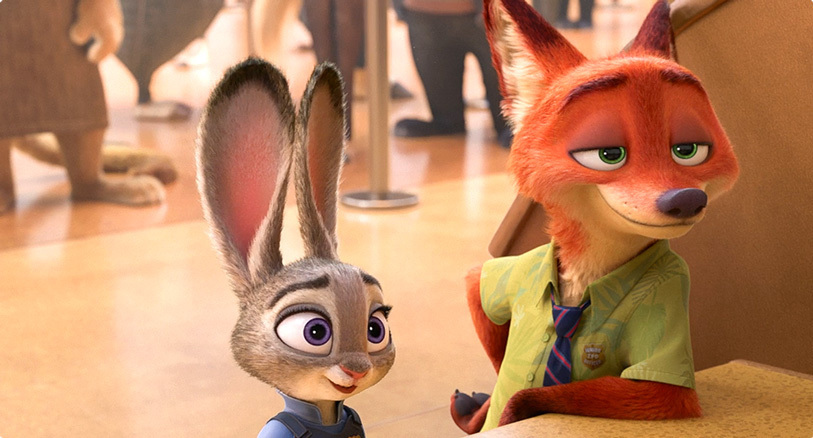
Judy Hopps (Ginnifer Goodwin) is a small-town rabbit with big-time dreams.   Since she was a small bunny, she was determined to become a police officer, in spite of the fact that no rabbit had ever been one.  After working through the police academy, she gets assigned to the police force in Zootopia, a metropolis in which predator and prey have been living side by side in harmony for eons.  Viewing Zootopia as a place where "anybody can be anything", Judy approaches her assignment with unbridled enthusiasm, even as her parents (Bonnie Hunt and Don Lake) worry about their little baby moving to the big city.

In her first day on duty, she meets a fast-talking con artist fox named Nick (perfectly voiced by Jason Bateman).  Eventually, the two end up working together on a missing persons case which, of course, goes deeper than it initially seems.  Also, not surprisingly, they become unlikely friends who learn to see each other's strengths in spite of their own bigoted views of the other's species.

For having a basic premise that seems, in all honesty, pretty "by the animation book", Zootopia displays a dazzling amount of ingenuity and imagination.  Unlike other similarly themed films, which made their cities look just like human cities with ridiculous car or fish related puns taking the place of genuine humor, the city of Zootopia is uniquely, delightfully animal based.  There are different boroughs with unique climates for a variety of species.  The buildings have beautifully organic designs that make many areas of the city resemble jungles.  There are even mini-neighborhoods for the rodents.  Every frame contains another 10 or 20 reasons to smile at the extreme amount of thought put into backgrounds that fly by with colorful glee.

Beyond the frequently surprising humor and the visual splendor to be found in this, one of the very best films from the John Lasseter-era of Disney animation, there are several messages that could not have been more timely.  If motivated by kindness and determination, we can make a difference.  Judging a group of people by the actions of a few is ignorant and dangerous.  It's better to get to know people than it is to simply believe rumors that we've heard about "their kind."  Most people are capable of surprising you with their depth and decency.  What hopeful and empowering messages for children and adults alike.

For parents considering this as a family outing, the only misgivings you may have involve a visit to a nudist yoga facility (of course, non-anatomically correct, but a few jokes about yoga positions au natural are still a bit on the crude side for a Disney film) and two instances of taking the Lord's name in vain, an increasing trend in family films, but still disappointing to those of us who are devout Christians.  Also, the plot involves some darker bits involving some animals "going savage" which may frighten very young children.  It's not the most "adult" of the Disney animated films, but it is more grown-up than anything they've done for a while.

However, these issues do not change the fact that this is an outstanding film and an early front-runner in the Best Animated Feature Oscar category.  The animation is uniformly stunning, the vocal performances filled with energy and warmth, the writing brilliantly nuanced, the music (by the terrific Michael Giacchino) alternatively gonzo and poetic, and the messages are head and shoulders above typical animated fare.  The directors, the minds beyond the terrific Wreck-It Ralph and Tangled have taken a premise that could have just been a rehash of the worst instincts in animation over the past two decades and created a complex, funny, and poignant reminder of the best of what it means to be human, even if it is a talking rabbit and fox that teach us about our own humanity.

Grade: A

Thursday, December 31, 2015

2015 Year-End Blog: The Box-Office Awakens


Recently, George Lucas caused a bit of a ruckus when he criticized Star Wars: The Force Awakens for being too "retro", declaring that he tried his best to do something completely different from film to film.  He has since recanted his statements, saying that he used poor analogies (comparing Disney to "white slavers") and that he was honored to have Disney as custodians of his vision and was proud of the work J.J. Abrams had done on the film.  

I'm sure that Lucas regrets saying what he did, but I don't think he didn't mean it.  However, I would posit that innovation (New spaceships! All CGI effects! Jar Jar!) without respect for character and dialogue is far more useless than brilliant nostalgia.  New and dumb is still dumb.  Familiar and brilliant is still brilliant.

I start my year-end blog with this because I find that my favorite films this year (my number one film the exception) follow the familiar and brilliant mode.  There have been terrific sequels, adaptations, and re-imaginings that play to the natural human inclination towards a beautiful mix of familiar and surprising.  Familiar and surprising.  Kind of a perfect way to describe this year in film.

First, my yearly disclaimer:  I haven't seen everything.  The list of acclaimed films that I have yet to see include Mad Max: Fury Road, Brooklyn, The Walk, Pawn Sacrifice, and countless others.  I do get to the theater more than most, but I'm still an amateur, which means I see a very small fraction of the films that are released every year.  That having been said, here's my year in review.

WORST OF THE YEAR:
Again, since I have to buy the tickets when I go to the movies, I tend to avoid movies that I suspect I won't like.  Even so though, I did go to two movies against my better judgement and the recommendations of professional critics: Pixels and Fantastic Four.  Both bad, but in very different ways.  I was hopeful for Pixels because the premise is fun (although a total rip-off of the third segment from the Futurama episode, "Anthology of Interest II") and the special effects looked terrific.  The movie was very much sold as a action-comedy in line with the likes of Men in Black.  Unfortunately, it was just another horrible Adam Sandler movie occasionally interrupted by fun action sequences.  The "jokes" were painful, the acting atrocious, and the plot developments (why did they have to forever ruin Q-Bert?!?) excruciating.

Fantastic Four was a different type of painful.  Since the last Fantastic Four films were criticized for leaning too much on the humorous aspects of the comics, the makers of the reboot obviously decided that it would be better if their take offered no humor at all.  Stoic, dour, and worst of all, boring, Fantastic Four was so determined to be different that it forgot to be good.

DISAPPOINTMENTS:
Minions - Cute.  That's the best I can say about this movie.  Many have criticized this film because it put the sidekicks in the starring roles, but the problem isn't the minions themselves.  If anything they're the biggest asset.  The problem is that it's not anywhere nearly as well-written as the Despicable Me movies.  The voice-over actors do their best (Sandra Bullock and Jon Hamm are clearly having the time of their lives as the villainous Scarlet and Herb Overkill), but the actor can only do so much with a plot that never gets going and jokes that choose easy toilet humor over the wit of the original films.

Poltergeist - I don't know if this really belongs in the disappointment column.  It's really as good of a remake of the original as could have been made.  It's a well-directed, well-acted, effectively scary movie that ends as a tribute to the strength of love found in the nuclear family.  The only problem?  It's a remake of a movie that did all of those same things, only better.  There's no sense of surprise, which is essential in a good scary movie.  It hits every beat (the t.v., the tree, the clown, the closet) from the original.  It would have been much more interesting to do a sequel with a new story, but for what it is, it's ok.  It's merely unnecessary.

HONORABLE MENTIONS:
Tomorrowland - Brad Bird is a brilliant filmmaker and this movie had been his pet project for a number of years, so it's understandable that expectations were sky high for this bit of retro-scifi.  Did it live up to the hype?  Not really.  The story is a bit thin and the film itself overlong, but it certainly has it's moments and it's unabashed optimism is certainly something that should be celebrated.  The performances are warm and engaging throughout, the music by Michael Giacchino is pitch perfect,  and it ends with my favorite final shot of the entire year.  Tomorrowland isn't game changing, but it's a delightful place to visit.

McFarland, U.S.A. - This one almost made my top ten.  I love this movie.  It's unashamedly sentimental, hokey, and inspiring, and it's one of the most uplifting movies of the year.  Disney does this type of underdog sports movie better than anyone and this story of determination and teamwork in a small, poor town is among their best.

Furious 7 - I have to be honest, I really hated this franchise at its inception.  It was everything that was awful about modern Hollywood action films.  I nicknamed the first movie "Pretty People Scowling."  Then Fast Five happened.  It was fresh and funny and surprising, with a vibe that was way more Ocean's Eleven than Fast and Furious.  Fortunately, the latest installment falls in line with the previous two.  It was utterly ridiculous, but unquestionably fun, with some of the best stunt work of any action film this year.  Plus, it ends with a surprisingly heartfelt tribute to the late star of the franchise, Paul Walker.  In fact, the ending was so perfect that I wish they would have just stopped the franchise there.  However, the movie made 1.5 BILLION (?!?) worldwide, so it's no surprise that an eighth film is forthcoming.

Cinderella - Congrats, Disney!  You not only made a film that didn't seem like a needless cash grab, but you made one that could understandably be considered the definitive telling of one of the most over-told stories in human history.  This movie is breathtakingly lush and romantic, but at it's core is the vital message that kindness is more powerful than selfishness.  What a better world we would have if everyone took that message to heart.

Jurassic World - If I were judging only on action sequences, this one would be high on the top ten list.  Unfortunately, the characters are barely one-note and the gender stereotypes are beyond ridiculous.  However, this is the first of the sequels to recapture the wonder of Spielberg's original vision.  Had the plot and the characterizations been more thoughtful, this could have been one of the year's best.

TEN FAVORITES OF THE YEAR
10. The Peanuts Movie
For years, I have bemoaned the tendency of family films to perpetuate the same message: "Be yourself."  I'm sorry, but while I understand the intent of that message, I have to assert that if everyone were to merely "be themselves" then no one would ever become more.  No one would grow.  No one would curtail horrible instincts.  We would all just wallow in a never-ending sea of self-obsession.

The Peanuts Movie, however, has a very different message at it's core: "Be kind, be honest, be willing to sacrifice."  I would much rather entrust the future of the world to a generation that believes in these morals.  Yes, the movie is simple, but Charlie Brown has never been more giving and heroic than he is in this wonderful little film.  Of course, we know that Charlie Brown is the epitome of not fitting in with the crowd, but this story gives him ample opportunities to be a "winner" in the eyes of his classmates.  It's something he's yearned for since his humble beginnings on the funny pages in the 50's.  Yet, he finds being an unsung source of selfless kindness the better path.  If only for it's beautifully and tenderly executed message, The Peanuts Movie is almost revolutionary in an increasingly selfish society, and therefore deserving of high praise.


 9. (tie) Ant-Man/Avengers: Age of Ultron
Yeah, I'm cheating.  Technically, there will be eleven movies on my list, but it's my list, so there  you go.  These movies are both pretty terrific examples of why Marvel Studios is kind of ruling the world right now.  Avengers: Age of Ultron (or as Honest Trailers calls it, Avengers: Roughly One Week of Ultron) has all of the wit, action, and exciting character dynamic as the original (contrary to what some of the more vocal critics have said).  By dint of being the second time we've seen these characters together, it can't be as joyfully surprising as the first Avengers movie, but this is still a delight from beginning to end.  It's been pretty publicly stated that the filming of this almost killed director Joss Whedon, but his trademark ease with humor and character are all over this movie as he uses an apocalyptic superhero movie to analyze the importance of, and the intricacies surrounding the concept of family, specifically the dynamics of generations replacing the ones that came before.  This film stands up to multiple viewings well, with each frame filled with action, drama, and humor.

Ant-Man on the other hand is a much smaller movie, and not just because of the stature of the titular hero.  It follows the basic plot structure of the original Iron Man film, but it does so by way of an Ocean's Eleven-style heist movie and it does so splendidly.  Paul Rudd is a perfect choice for the lead as he is one of the only actors in Hollywood who can simultaneous portray sincerity and sarcasm with equal authenticity, and that combination makes Ant-Man feel like a snarky action-comedy with a surprising amount of heart.  Personally, I can't wait to see this character interact with the more famous of his MCU cohorts.


 8. Mr. Holmes
Mr. Holmes is a highly intelligent film that imagines Sherlock Holmes as an octogenarian facing the challenges of increasing senility.  He spends the bulk of the movie trying to recount the specifics in the case that led him to retirement, but he finds his flashes of inspiration more frequent as he spends time with the young son of his housekeeper.

This is a slow, simple, gentle movie that is propelled by terrific casting and atmosphere, and one of the best performances by one of the world's greatest actors, Ian McKellen.  Portraying Holmes at two different ages, one before losing his mental faculties, one after his increasing memory loss, McKellen is extraordinary in this film.  This is an example of a movie that would have been very good regardless, but with this performance, it's great.

7.  Shaun the Sheep Movie
Aardman Animation has been a critically-acclaimed powerhouse for decades now, but to be honest, it's been quite some time since I've felt they achieved the heights of brilliance they displayed in the 90's.  Shaun the Sheep Movie is a return to that brilliance.  Shaun manages to be hilarious, fast-paced, and filled with heart, while doing so without a single line of dialogue.  That's right, this is like an animated, very British, Buster Keaton movie with complex visual gags and delightful characterizations galore.  If you yearn for the brilliance of Wallace and Gromit, it's here in full display.  Enjoy!


 6. Mission: Impossible - Rogue Nation
When I say that Tom Cruise is utterly insane, it's not meant as an insult.  Is there any other big-time Hollywood movie star that would dangle from the side of a plane as it takes off and flies for the sake of keeping the audience involved?  While I'm not convinced he's a great person, there's no question that he's 100% devoted to his craft, and that devotion is on display in every sequence of Rogue Nation.

Besides Cruise and his insane work ethic, this movie is filled with other virtues.  It's thrillingly paced and impeccably cast, with a particular stand-out performance from Rebecca Ferguson as a British agent with unclear loyalties.  This franchise has gotten into the bad habit of making the female characters disposable.  Here's hoping Ferguson bucks the trend and returns because she's fantastic.


 5. Creed
I know that this is considered heresy, but I actually think Creed is a better film than the original Rocky.  Sure, it's mostly a beat-for-beat remake and it's missing the original's rough and tumble charm, but Creed is a much more focused journey and, frankly, contains a more nuanced and depth-filled performance from Sylvester Stallone, a performance that will surely garner an Oscar nomination if not a win.

The rest of the performances are terrific as well, especially Michael B. Jordan as the son of boxing legend Apollo Creed and Tessa Thompson as his "Adrian", the immensely likable and talented Bianca.  Director Ryan Coogler skillfully balances sentiment, drama, and character resulting in a movie that manages to enthrall and inspire.  Gonna fly now, indeed.


4. The Martian
I haven't read the celebrated novel upon which this movie is based, but considering the extraordinary achievement of this film, it must be one heckuva read.  Matt Damon turns in a career best performance as Mark Watney, an astronaut mistakenly thought for dead and left behind after an expedition to Mars.  His efforts to survive and make contact with the world beyond are reminiscent of Tom Hanks' similar journey in Cast Away, but The Martian is not only a taut survival drama, but a surprisingly funny character study.

The Martian is also one of the best films in the career of director Ridley Scott, and that is high praise indeed.  Every frame is a work of art and every emotional hit is perfectly balanced.  The Martian is, quite simply, one of the most thoughtful, inspiring,  and exquisite works of cinematic science fiction in film history.


 3. Bridge of Spies
Bridge of Spies, the true story of an insurance lawyer, played by Tom Hanks, who is roped into representing an accused Communist spy at the height of the cold war, could not be a more timely film in our political atmosphere of building walls and de-humanizing anyone considered "the enemy."  As the film progresses, there is no question of the guilt of the accused (Mark Rylance, in an Oscar worthy performance), however, the movie shows that, in spite of the differing world views of the two characters, they are both indisputably, sometimes painfully, human, and as a result, actually capable of understanding and respecting one another, even while disagreeing.

Spielberg shows, once again, that he knows how to handle a camera like no other living filmmaker.  He's an expert about showing, not telling, giving us all the information we need without depending on an over-expository script.  Speaking of the script, it's a work of subtle nuance and memorable dialogue created by Mark Charman and the Coen brothers (yes, those Coen brothers).  While it does contain the Coen brothers celebrated humanity and quirk, it also has a refreshing optimism that has certainly not been the hallmark of their writing style.  A masterwork that stands proudly among Spielberg's best.


2. Star Wars: The Force Awakens
I have great respect for the talent and vision of George Lucas.  However, I have to state emphatically that his views about J.J. Abrams epic, nostalgic, surprising, heartbreaking, thrilling, deftly funny take on the Star Wars legacy are simply wrong.  That having been said, I very much appreciate that he had the humility to step aside and realize that he was not going to give the legions of Star Wars fans the movie they had been longing for since 1983.  In fact, the kindest thing that he said about Episode VII is that it was definitely a movie for the fans, and he's not wrong about that.

Yes, The Force Awakens has a plot structure that will be familiar to fans of the original trilogy, especially of the first Star Wars.  Yes, it has a desert planet and a snowy planet.  Yes, there's a droid with valuable information being hunted by the bad guys.  However, for every moment of nostalgic familiarity, there are three or four of thrilling surprise.

One of the most delightful things about The Force Awakens is a re-dedication towards character and dialogue.  Instead of the prequel's stilted plotting and painful dialogue, we're given characters rich with hope and possibility, and dialogue that will likely stand tall among the most quoted lines of the original trilogy.  Plus, we get a villain that is not only intriguingly flawed, but a very pointed commentary on fandom gone horribly, horribly wrong.

J.J. Abrams was absolutely the right man for the job.  The Force Awakens is the best Star Wars movie we've seen in at least 35 years, if not more.


1. Inside Out
Let me be clear, I loved Star Wars: The Force Awakens.  I could not have loved it more.  It's one of the most enjoyable and thrilling blockbusters in decades.  However, Inside Out did something that not even Star Wars could do.  It changed me.

A day-glo colored fantasy about the inner-workings of the mind of an 11 year-old girl, Inside Out is a work of absolute genius, but beyond the imagination bursting from the seams of this instant classic film, it is a movie that makes us think about the way we interact with one another and how we choose to develop our personalities and emotions.  Since my first viewing of Inside Out, I've had countless conversations with my wife about subjects that it brought up.  What islands of personality am I creating?  Which emotion do I let run the controls and why?  Can I truly be empathetic with others if I can't communicate my own sadness?  Isn't is interesting that the most profound moments of joy I've experienced in my life have often been preceded by sadness?  Are memories associated with mixed emotions inherently more powerful?  When's the last time any film, let alone an animated "children's" film, inspired such personal reflection?

Also, what a wonderful way to engage in a dialogue with children about their emotions.  Director Peter Docter wrote Inside Out in an effort to understand his tween daughters' increasing eye-rolls and sass-talk, but what he did was create a masterpiece that is so complex and rich that it's legacy will not merely be found in its entertainment value, which is extraordinary, but also in its ability to inspire personal introspection and change.  It's this kind of power that elevates this from being a mere movie to being a profound and lasting work of art.


Well, there is is, 2015.  A fun and history-making year of film.  Now to look forward to dawns of justice, civil wars, forgetful fish, rogue rebels, and going where no one has gone before in 2016.  Should be fun!

Wednesday, November 25, 2015

Mini Reviews: The Good Dinosaur and Mockingjay Part 2

Mini Reviews: The Good Dinosaur and Mockingjay Part 2
The Good Dinosaur/Rated PG/Dir. by Peter Sohn/100 min./Pixar Animation Studios
The Hunger Games: Mockingjay Part 2/Rated PG-13/Dir. by Francis Lawrence/137 min./Lionsgate

The Good Dinosaur
It may have endured one of the more tumultuous gestation periods of any Pixar film, but The Good Dinosaur has finally arrived and it is a wholly unique and worthy entry into their canon of brilliance.

Of course, the most daunting challenge of this simple story of a boy (dinosaur) and his dog (human boy) is that it comes out the same year as Inside Out, one of Pixar's very best films.  However,  to compare the two is as misguided as comparing Fantasia with 101 Dalmatians just because they are both from Disney.  As it is, The Good Dinosaur stands on it's own quite well, thank you very much.

The story is an interesting combination of simple and surprising.  As the commercials have well shown, the central premise is that the dinosaurs never died off because the meteor missed the Earth.  What's interesting is that this premise has little to do with the story itself.  It's an American story, a settler's story.  It feels like the type of story that Disney himself would have championed in the 50's or 60's, just with actual people as pioneers of the American west instead of dinosaurs.  A little The Incredible Journey by way of Old Yeller (don't worry though, the dog doesn't get rabies).

While the story is simple, the animation is perhaps the most stunningly complex ever developed at the studio.  Aside from the admittedly cartoonish looking characters, this has the same eye candy delight as a DisneyNature documentary.  There's never a frame that isn't jaw-droppingly real and breaktakingly lush.  The visuals alone are worth the price of admission.  Fortunately, the movie is sweet, moving, and filled with worthwhile messages about overcoming self-doubt and embracing friendship, even with someone you once considered an enemy.

The Good Dinosaur gets a well-earned B

The Hunger Games: Mockingjay Part 2
Mockingjay should have been one epic movie.  Period.  This trend of dividing books into half just to milk the franchise for all it's worth may be financially lucrative, but it's creatively bankrupt.  The ending of Part 1 felt jarringly abrupt and the beginning of Part 2 feels very poorly developed.  I'm excited to see these two joined together eventually so I can see a completely story, instead of the weird, separated-by-a-year, mini-series we get.

That having been said, The Hunger Games has been a smart, if brutal, pop culture phenomenon and the ending doesn't pull any punches.  This is a war movie, pure and simple.  The emotions are real and the threat is palpable.

However, a film like this begins and ends with the skills of the actors and each actor leaves nothing on the table.  Especially surprising was Josh Hutcherson's performance as Peeta, who up to this point in the series has been little more than Lois Lane to Katniss' (Jennifer Lawrence) Superman, constantly getting in trouble and constantly getting saved.  In Mockingjay Part 2, Peeta is given a little more meat to his character and Hutcherson delves into the role with relish.  Lawrence is terrific, as always, but she's doing the same "I don't want to be a hero, but I will if it's what's required" song and dance that she's perfected throughout the series.  Hutcherson feels like he's actually finding another level to his character, and that's a nice surprise.

Storywise, The Hunger Games has messages that are important, especially with current events that may blur the lines or right and wrong.  It does what great art is supposed to do, it makes us think a little more deeply about ourselves and about the human condition in general.  However, it just doesn't congeal as a complete movie.  It constantly feels lacking, and the biggest thing that's lacking is Part 1.

Grade : B (for Part 2 by itself), A- (for Mockingjay as a complete story) 

Tuesday, August 18, 2015

Of Stilettos and Stegosaurus: Sexism and the Blockbuster


This summer has been much like any other at the movies.  Heroes have fought robots and dinosaurs and covert spy organizations.  Occasionally lessons have been learned, but usually they're secondary to the fiery explosion chasing the protagonist down a hall.  In all honesty, I absolutely love summer movies.  Steven Spielberg and George Lucas helped cultivate a yearly homage to B-movie heroics by way of A-movie special effects, direction, and (often) acting and because of their efforts, we have one season a year that we can go to the movies with a pretty good chance of seeing things we've never seen on screen before.

Summer movies have been accused of many things throughout the years: the dumbing down of mainstream entertainment, the shift from original films to endless franchises, the importance of opening weekend grosses.  However, this year one of the most common accusations against the blockbusters films of summer has been sexism.  Of course, Hollywood has never been a haven of enlightenment regarding gender equality, but this summer the call against blockbuster sexism has risen to new heights.

I recently had a friend share a well-reasoned, well-written article deriding the film Avengers: Age of Ultron as inexcusably misogynistic.  In the case of this particular movie, I believe that the scenes and character arcs that are believed to be sexist are really being misinterpreted, especially considering the fact that the director and writer Joss Whedon has long been a champion for strong female characters (frankly, the most sexist thing about AoU is the fact that there are roughly 1,324 main characters, but there are only 3 female characters that have any influence on the plot whatsoever). However, after I asserted this belief in my friend's comment area, another of his friends took me to task.  I've never been one to wage battle on the fields of Facebook, so I didn't really get in to it, but while his arguments didn't sway my views (and if you want to know my defense of perceived areas of sexism in AoU, let me know, I'll be happy to share my thoughts), they did get me thinking more about the way women are written in blockbuster films.

If the last few years have taught us anything, it's that women go to the movies far more than executives used to believe.  Unfortunately, movie executives still don't understand female moviegoers and writers still fail to write good female characters.  They still believe that in order for a female protagonist to have appeal to a female audience, said protagonist must spend most of their time worrying about their clothes or worrying about if they're being taken seriously or worrying about their romantic relationship with a man.  The Twilight films were hugely popular, but holy cow is the lead character a step back in the feminist movement.  I mean, she spends three films with her sole defining characteristic being her romantic relationship with a man and then she literally gets her personal strength when she allows her husband to suck away her humanity.  Seriously.  

Yet I digress.  Right now I'm ruminating on gender issues in films that are supposedly targeting all genders, ages, and races: the summer blockbuster.  These films are greenlit by how effectively they appeal to all demographics, so one would think they should be the most progressive movies in regard to gender equality.  Of course, they are not.

Beyond the aforementioned Age of Ultron, the watchcry of sexism has been sounded against many other films this summer.  Mission: Impossible-Rogue Nation is a blast of a film, but it still manages to continue M:I's proud tradition of rotating sexy female agents who can kick butt in skimpy dresses,  while maintaining the same male agents who are allowed to do the same butt kicking fully clothed.  Minions has one major female character, a character that has been driven to criminal dementia by her lifelong desire to be a pretty and popular girl.  One of the only summer blockbuster that has escaped this trend is Pixar's Inside Out, a movie in which the three central protagonists are female (granted, two of them are the personification of the other one's emotions, but still) and none of those characters are defined by their relationships with their male counterparts. (I've heard Mad Max: Fury Road is another example of a summer blockbuster that doesn't play into antiquated Hollywood attitudes towards women, but I haven't seen it so I can't speak to it directly.)

However, perhaps the most telling example of sexist attitudes in Hollywood blockbusters is the biggest blockbuster of the year, Jurassic World.  (Please be warned, I cannot discuss these issues without spoilers.  If you haven't seen JW, please stop reading now.  SPOILER ALERT!!!!!!)
Much like other summer blockbusters, I very much enjoyed Jurassic World.  It is really the first of the Jurassic Park sequels to capture the excitement and wonder of the original.  It's well directed, has a fun sense of humor, and special effects that fill the viewer with equal parts awe and dread.  However, the two main characters are perhaps the most shallow gender stereotypes committed to any film with Steven Spielberg's name in the credits.

Before I get to them though, allow me to address an area that has garnered criticism that I feel is unjust: the admittedly horrific death of Zara, a female character whose only crime is not being a particularly good nanny in spite of her profound British-ness.  I have heard some say that the fact that the most disturbing death scene in the movie involves an innocent woman is clearly sexist.  Actually, if you look at the series as a whole, it's pretty progressive.  Innocents have died in the previous films, but never a woman.  The movie finally shows that dinos really couldn't care less the gender of their meal.  Also, it's been said that her death scene is particularly mean-spirited, but, once again, I'd like to direct your attention to the previous films, especially The Lost World and it's callous dispatching of Eddie Carr, a man who is easily the kindest, least selfish character of the film, but is thanked by being ripped in two by a pair of T-Rexes. 

Now, back to the two leads.  Let's start with how these characters are introduced.  First we meet Claire Dearing, the park operations manager played extremely well by Bryce Dallas Howard.  When we're introduced to Claire, she's alone in an elevator nervously rehearsing the names of the executives from Verizon Wireless that she's about to meet.  She's clearly worried and seemingly out of her element.  However, when the elevator doors open, her self-doubt dissolves and she morphs into the epitome of professional confidence and persuasion.  "Welcome to Jurassic World," she says with a cool, executive ease.

Conversely, when we first meet Owen Grady, an ex-Naval officer turned animal expert winningly played by Chris Pratt, he is lording over a pack of velociraptors, controlling gaze and actions solely with the authority of his voice and a clicker.  In those two scenes we learn that the female protagonist appears strong, but is actually self-doubting and highly strung, while the male protagonist is so awesome and so confident that he is able to BOSS AROUND VELOCIRAPTORS.

These characteristic trends continue throughout the film.  When the characters first interact, we learn that they had been on one date, however she was too uptight and he was too effortlessly cool for it to work.  With every tragic disaster that threatens the safety of human life, Owen is confident, aggressive,  and invariably right, while Claire is nervous, non-commital, and invariably wrong.  In spite of the fact that her nephews just watched her save Owen's life by shooting an attacking dinosaur, the boys immediately make it clear that they don't care if she's around as long as Owen's there to make them feel safe.  Even in the end, when Claire finally steps up and risks her life to save everyone by facing down a T-Rex (!!!), the script makes sure that she's running from the beast in fashionable stilettos. (Sidenote:  As ridiculous as this wardrobe choice is, Bryce Dallas Howard is like an Olympic athlete in those stilettos.  Her running in those shoes is perhaps the single most amazing bit of stunt work in the movie.)  As the credits roll, she too has been bewitched by the overwhelming awesomeness of Owen and has fallen in love with him in spite of his rugged confidence and easy going attitude.

Clearly, such broad and shallow characterizations are not necessary in any conceivable way, so what could have been done?  Well, the simple solution is don't be sexist.  Honestly, just let Claire be as strong as Owen.  Put her in real-people shoes, let her confidence not be a facade, let her make smart decisions, don't force a romantic relationship -  all of these would have been acceptable.

However, as I thought about it, I couldn't help imagine a different movie.  Now follow me here, even if it seems ridiculous.  Firstly, don't make Claire the nervous park manager, give that role to Lowry, the fanboy with a love of all things dino,  played by the awesome Jake Johnson.  Johnson's terrific deadpan was under-utilized in the movie anyway and his natural nervous energy would have given the role of a park manager who feels control slipping through his fingers a more genuine sense of humor and chaotic dread. (I know that the idea of giving the main female role to a man seems the opposite of progressive, but I'm getting to that)  In the film as it currently exists, Claire's arc involves respecting the dignity of animals that she had previously viewed through the antiseptic eyes of a bureaucrat.  In this version, Lowry would grow from a dino-fanatic who really only saw them as giant action figures to a respecter of their place in the world as real living beings.

Now here's where things could get interesting.  Keep the character of the ex-Navy paradigm of coolness exactly the same, except this character becomes Claire Dearing.  Claire becomes the character who successfully communicates with the raptors, which actually makes sense because the raptors are female, so it would follow logically that they would respond to a female becoming their alpha.  Claire is strong, smart, laid-back.  Lowry is smart yet nervous, and discovers his strength through the events of the story.  Plus, he wouldn't have to run from a T-Rex in high heels.  Oh, and also, they don't fall in love.  I know, unthinkable, but the fact of the matter is that any relationship founded on the fact that both parties managed to not be eaten by dinosaurs is doomed to fail anyway.  Just get rid of the romance angle all together.  This is a story with potential.  It keeps everything about the movie that works, but it offers an interesting and exciting take.

Of course, the solution to misogyny in Hollywood isn't "just swap the genders of the main characters."  It's simply to not be sexist.  Would your male protagonist have the same character arc regardless of his interactions with female characters?  Then show the same respect to your female protagonist.  Is your male protagonist allowed to be fully-rounded without a romantic relationship?  Then allow the same for your female protagonist.  Does you film have nine male heroes and one female hero?  Yeah, maybe re-think that.

I'm not sure if movies are getting worse in their treatment of women or if I'm just becoming more disturbed by it, but either way, it needs to change.  Not only do women need to stop supporting this type of misogyny, but men need to recognize these trends in their favorite films and demand better female representations in popular films.    

I suppose there is some progress being made.  Katniss Everdeen is a far better role model than Bella Swan, even if she's still forced into an odd love triangle.  At least her initial heroic motivations aren't centered around her romantic identity.  Yes, Black Widow is still forced to fight the world in tight pants, but at least her male counterparts are equally embarrassingly dressed, and yes, she falls in love in AoU, but so does Bruce Banner and that relationship is not the defining characteristic of either of their multi-film arcs.  As I mentioned above, Inside Out manages to acknowledge general gender differences without resorting to pathetic stereotypes.  I just hope that some day we'll see this type of dedication to strong female characters as the norm, not the exception.


Thursday, August 6, 2015

Movie Review: Shaun the Sheep Movie

Shaun the Sheep Movie/Aardman Animation/Dir. by Mark Burton & Richard Starzak/Rated PG/85 min.

In the early and mid-nineties, Aardman studios gained prominence with a series of animated shorts built around the characters Wallace and Gromit.  These shorts were critically acclaimed, award-winning, and extremely popular, particular in Aardman's homeland of England.  The third short in the series, A Close Shave, introduced a new character, a mischievous little sheep named Shaun.  He was popular enough to get his own BBC t.v. series and now that series has received the big screen treatment.  However, unlike the average t.v. cartoon-to-feature length project, Shaun the Sheep Movie is not only one of the finest feature length Aardman films, it's one of the most delightful, charming, and consistently hilarious films of the year.

Shaun and all of his friends at Mossy Bottom Farm, on a vaguely English countryside, have gotten into a bit of a rut.  The Farmer has aged from a hip young man who likely has an extensive vinyl collection of The Smiths to a balding, single farmer with a paunch who has dedicated himself to his animals and, by extension, an exacting schedule.  When the animals decide they need a break from the routine, they get The Farmer to take an extended sleep (by means far too funny for me to spoil here) and put him in a camper trailer so they can make use of the amenities of his house.  Unfortunately, a series of unfortunate events leave that camper trailer on a random street in The Big City and The Farmer with amnesia.  It's up to the ragtag group of farm animals to find him and restore things to their proper order.  

The plot of Shaun the Sheep Movie is breezy and simple, but the humor is surprisingly sophisticated.  The movie is told with a visual spark and not a single line of dialogue.  Told from the point of view of animals, the humans mumble incomprehensible gibberish and the animals communicate via "baas and "barks" and delightfully animated expression.  It's as if Aardman decided to remake Ferris Bueller's Day Off with the comic sensibility of Charlie Chaplin, populated by British livestock.

This is a short review, but this film doesn't require a long, drawn-out meditation.  It is, quite simply, one of the best movies of the summer.  A short, surprising, delightful, frothy little film to cleanse the pallet of world-ending, special-effects driven blockbusters.  Hopefully, the public will discover this little gem.  I'd love to see it become as successful financially as it is creatively.

Grade: A